




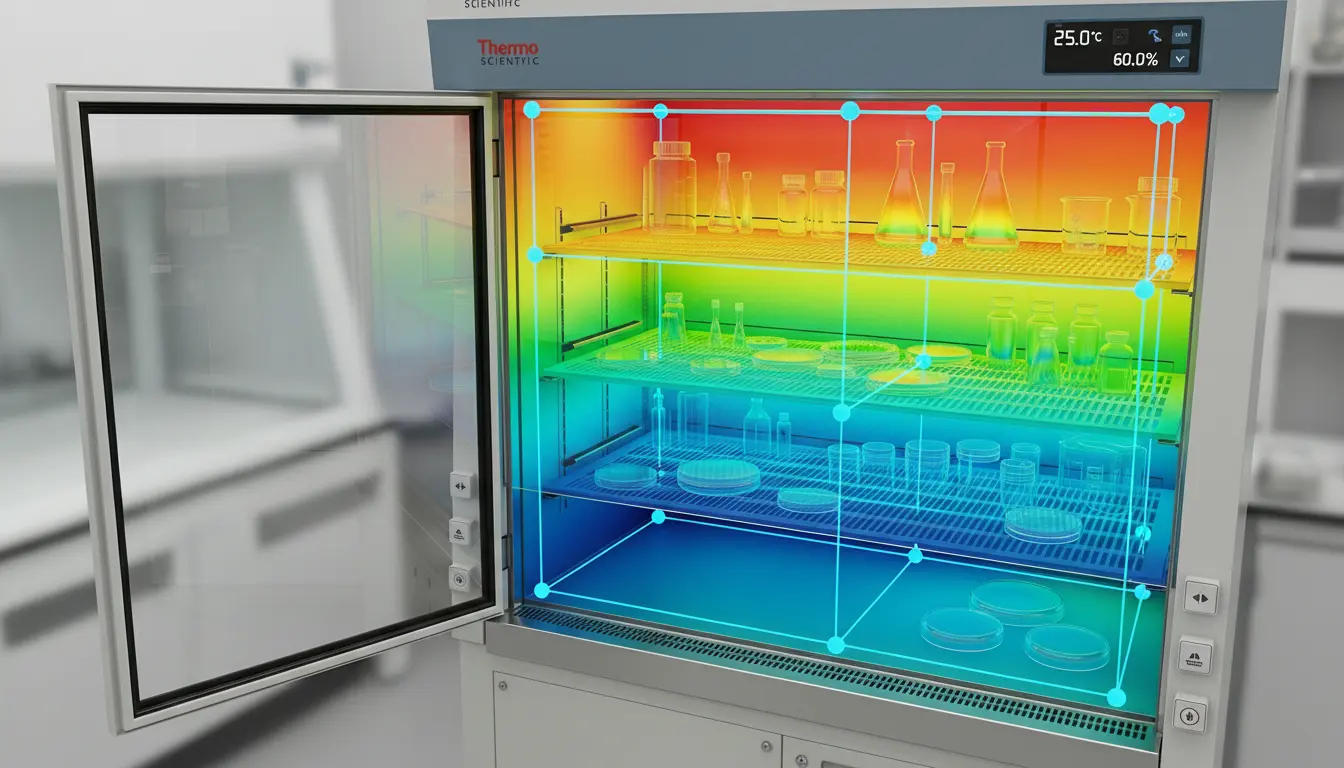
Validate ICH Compliance. Document Uniformity. Protect Your Shelf-Life Studies.
The Precision Mandate: Beyond Temperature
Stability chambers and humidity cabinets are the heart of shelf-life testing. Unlike a standard refrigerator, these units must maintain a precise balance between thermal energy and moisture content. Even a minor “dry pocket” or “condensation zone” can skew your stability data, leading to failed assays or inaccurate expiry dating.
Humidity Chamber Mapping is a high-accuracy validation process that proves your chamber maintains uniform conditions across the entire 3D storage space.
Compliance with ICH & Global Regulatory Standards
✓ ICH Q1A (R2) Stability Testing
The International Council for Harmonisation (ICH) mandates that stability studies must be conducted under controlled environmental conditions. Our mapping studies provide the documentation required to prove that your chamber meets the strict tolerances (±2°C and ±5%RH) defined for long-term, intermediate, and accelerated testing.
✓ Identifying Humidity Gradients
Humidity is notoriously difficult to maintain uniformly. Airflow patterns and door seals often create zones where moisture levels drift. Our mapping identifies these gradients, ensuring your samples are exposed to the exact conditions required by your protocol.
✓ Mean Kinetic Temperature (MKT) & Dew Point Analysis
We provide the advanced statistical analysis needed to evaluate the impact of any minor fluctuations, including MKT and Dew Point calculations to ensure no condensation risk exists for your packaging.
Our Stability Mapping Methodology
| Step | Action | Validation Goal |
|---|---|---|
| 1. Sensor Grid | Placement of matched Temp/RH sensors in all 8 corners and center. | Map the 3D “working zone” of the cabinet. |
| 2. Equilibrium Study | Monitoring the unit as it reaches the set point. | Document the “Time to Stability.” |
| 3. Uniformity Study | Continuous logging for 24–72 hours. | Prove stable conditions across all shelves. |
| 4. Stress Testing | Door opening and power-loss recovery tests. | Measure the chamber’s resilience to daily use. |
| 5. Data Analysis | Statistical summary of Max/Min/Average/Drift. | Audit-ready 21 CFR Part 11 reporting. |
Engineered for High-Accuracy Environments
- Matched Capacitive Sensors: We use high-accuracy sensors with a typical accuracy of ±0.2°C and ±2.0%RH to detect even the slightest chamber drift.
- Non-Invasive LoRaWAN® Signals: Sensors transmit through double-walled, stainless steel cabinets without the need for cables that could compromise the door seal.
- NIST-Traceable Calibration: Every mapping logger is calibrated at multiple points (e.g., 25°C/60% and 40°C/75%) to ensure performance at your specific ICH set-points.
- Rapid Reporting: Our validation software generates heatmaps and statistical summaries immediately following the study.
Stability Chamber Mapping FAQ
Q: Do I need to map my chamber while it’s empty or full?
A: Initial validation (OQ) is typically performed empty. However, periodic re-validation (PQ) should be done with a representative load, as the product mass significantly impacts airflow and humidity distribution.
Q: How often is re-mapping required?
A: Most Quality Management Systems (QMS) follow a 12-month re-validation cycle for stability chambers due to the critical nature of the data they generate.
Q: What if my chamber fails a mapping study?
A: We don’t just provide data; we provide solutions. If a “wet spot” or “hot zone” is found, our engineers can help you identify if it’s an HVAC baffle issue, a failing ultrasonic humidifier, or a simple shelving obstruction.
