




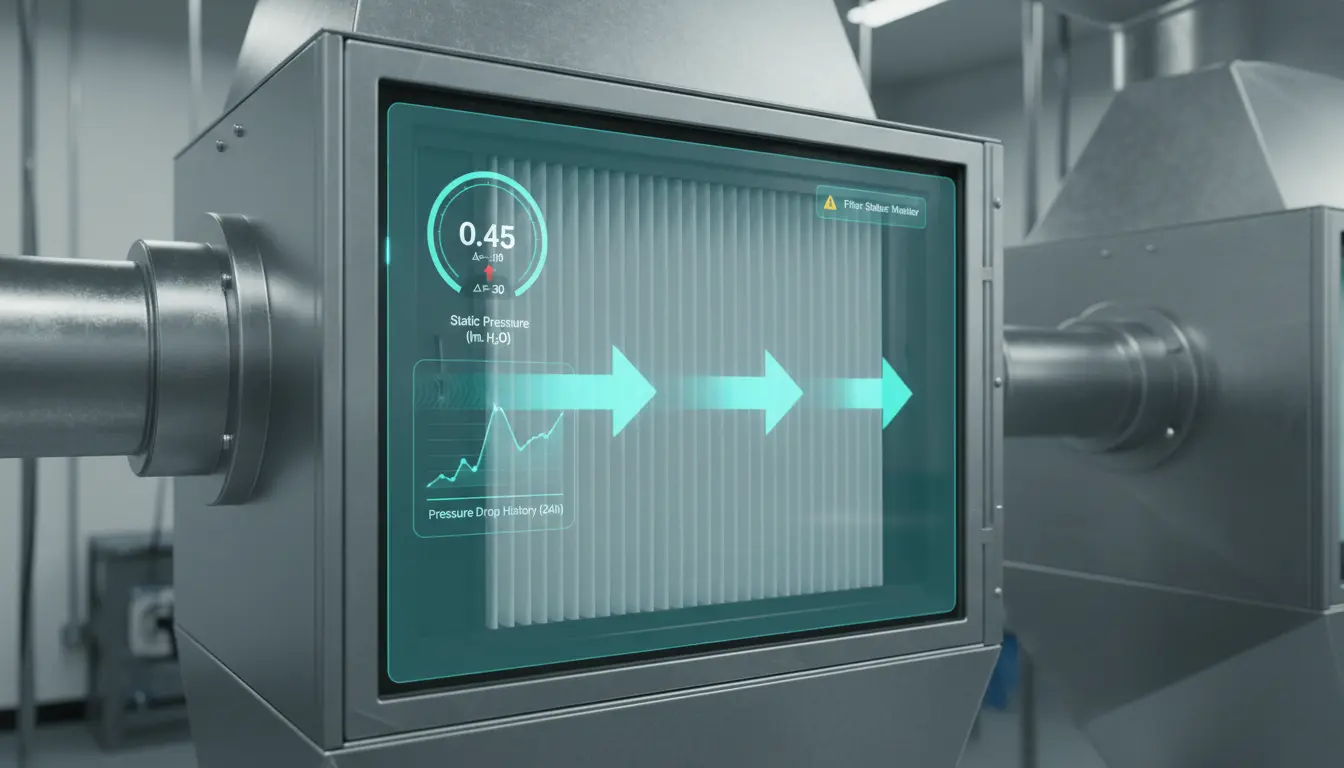
Stop Changing Clean Filters. Start Saving Energy with Predictive Static Pressure Tracking.
The Hidden Cost of “Calendar-Based” Maintenance
Most facilities change HVAC filters every 3 or 6 months. This is inefficient:
- Changing too early: You waste money on filters that still had 40% life remaining.
- Changing too late: Clogged filters restrict airflow, forcing your motors to work harder, skyrocketing energy bills and leading to premature blower failure.
Our Predictive Filter Monitoring System uses high-precision differential pressure (ΔP) sensors to track the actual “loading” of your filters in real-time. You only change filters when the data says it’s time.
Why Leading Facilities are Moving to Predictive Airflow IoT
✓ Drastic Energy Reduction
A clogged filter increases the static pressure your fans must overcome. This can increase energy consumption by up to 15-30%. By monitoring the exact point of diminishing returns, our system ensures your HVAC runs at peak efficiency 24/7.
✓ Extended Equipment Lifecycle
Overworked motors run hotter and fail faster. By maintaining optimal airflow, you reduce the strain on your fans and compressors, extending the life of your multi-million dollar HVAC assets by years.
✓ Indoor Air Quality (IAQ) & ASHRAE Compliance
For hospitals, labs, and cleanrooms, filter integrity is a health mandate. Our system provides a continuous audit trail of filter performance, ensuring you meet ASHRAE 52.2 and 62.1 standards for air changes and filtration efficiency.
✓ Predictive Failure Alerts
If a filter suddenly shows zero pressure drop, it means the filter has collapsed or is missing—allowing unfiltered air into your space. If the pressure spikes instantly, it could indicate a blocked intake. Receive instant SMS alerts before your air quality is compromised.
The ROI of Smart Filtration
| Metric | Traditional Maintenance | Our Predictive IoT System |
|---|---|---|
| Replacement Logic | Calendar date (Guesswork). | Real-time static pressure load. |
| Energy Consumption | High (due to restricted airflow). | Optimized (lowest possible fan strain). |
| Labor Costs | High (checking filters manually). | Low (service only when alerted). |
| Air Quality Integrity | Unknown between checks. | Continuous 24/7 verification. |
Engineered for Industrial HVAC Systems
- Wireless LoRaWAN Connectivity: Our sensors transmit through heavy mechanical room walls and up elevator shafts without needing Wi-Fi or complex wiring.
- 10-Year Battery Life: Designed for hard-to-reach rooftop units (RTUs) and air handling units (AHUs).
- High-Accuracy Piezo-Sensors: Detects pressure changes as small as 1 Pa, allowing for precise tracking of HEPA and MERV-rated filters.
- Plug-and-Play Installation: Magnetic mounts and “tap-in” pressure tubes allow for a 15-minute setup per unit.
HVAC Filter Monitoring FAQ
Q: How does the system account for Variable Frequency Drives (VFDs)?
A: Our smart dashboard correlates pressure data with fan speed. We normalize the readings so you get an accurate “Filter Health Score” regardless of whether your fans are running at 20% or 100% capacity.
Q: Can this help us achieve LEED or WELL certification?
A: Yes. Continuous monitoring of filtration efficiency and air pressure is a key component in earning credits for Indoor Environmental Quality (IEQ).
Q: What is the typical ROI on this system?
A: Most facilities see a return on investment within 9 to 14 months through combined savings in filter procurement, labor, and reduced energy bills.
