




Verify Sterility. Document Heat Penetration. Ensure Annex 1 & ISO Compliance.
The Sterility Gap: Why Pressure Gauges Aren’t Enough
A gauge that says 121°C on the outside of your autoclave doesn’t mean your load reached that temperature on the inside. “Cold Spots” caused by trapped air pockets, overloaded chambers, or clogged drain lines can lead to incomplete sterilization, risking patient safety and batch failure.
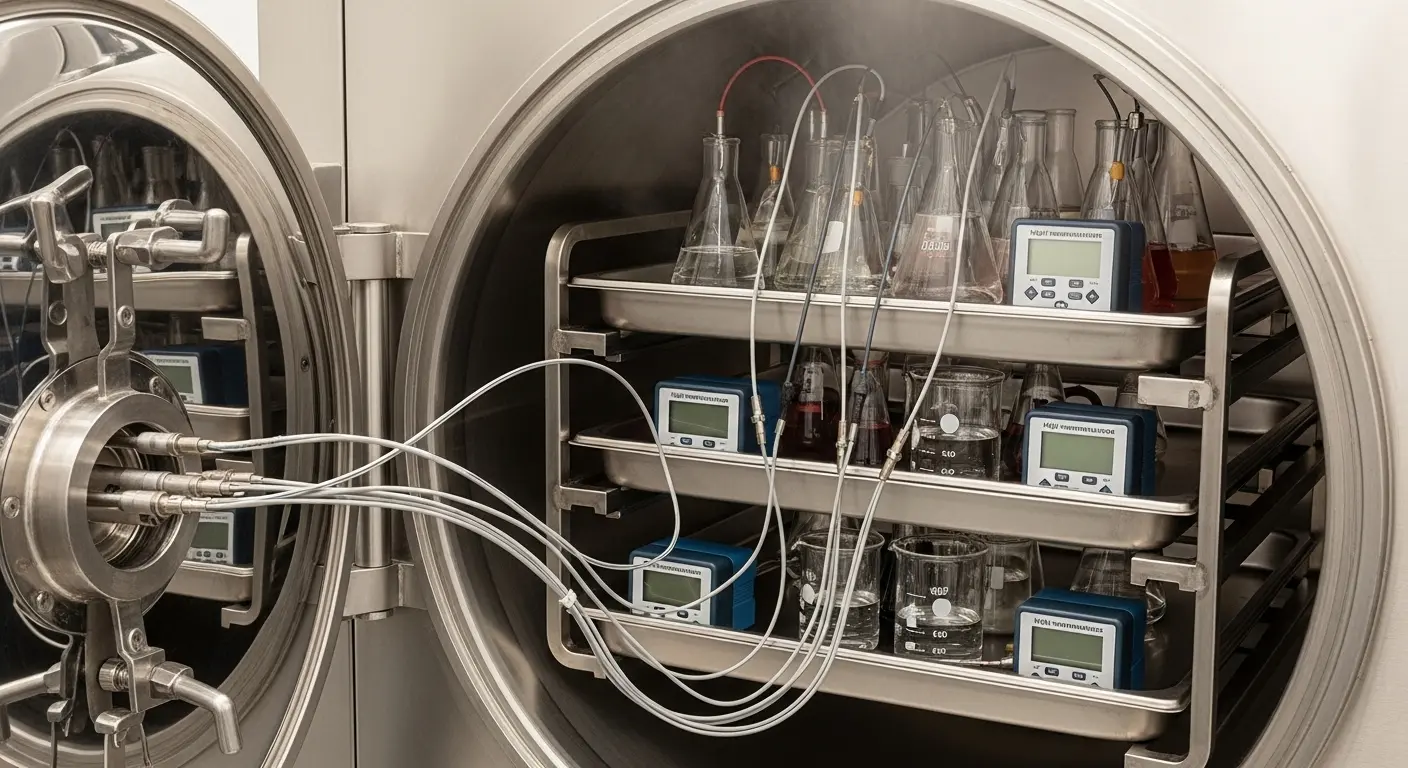
Autoclave Thermal Mapping (Validation) is the process of placing high-temperature sensors directly inside the chamber and within the “coldest” part of the load to prove that every inch of the material reaches the required lethality.
Critical Validation for Regulated Labs & Healthcare
✓ Heat Penetration Studies
It is one thing to heat the chamber; it is another to heat a 5-liter carboy of liquid or a dense surgical kit. We use flexible, high-temperature probes to measure the temperature at the core of your most challenging loads.
✓ Saturated Steam & Air Removal Tests
For steam to sterilize effectively, it must be saturated. Our mapping studies identify “Air Pockets” that prevent steam contact. We help you validate your Bowie-Dick tests and vacuum-pulse cycles to ensure total air removal.
✓ Lethality Calculations (F₀ Value)
Our software automatically calculates the F₀ value (the equivalent time at 121°C). This provides the mathematical proof that the biological kill-rate was achieved, even if the cycle fluctuated slightly.
Our Autoclave Mapping Methodology
| Step | Action | Validation Goal |
|---|---|---|
| 1. Empty Chamber Study | Mapping the distribution of the raw chamber. | Identify “Cold Spots” near the drain or door. |
| 2. Loaded Chamber Study | Mapping with “Worst-Case” load configurations. | Verify heat penetration in dense materials. |
| 3. Biological Correlation | Placing BIs (Biological Indicators) next to sensors. | Correlate thermal data with actual microbial kill. |
| 4. Analysis | Calculation of T_min, T_max, and F₀. | Statistical verification of sterilization. |
| 5. Reporting | Full IQ/OQ/PQ Validation Package. | Audit-ready 21 CFR Part 11 Documentation. |
Engineered for Extreme Environments (134°C+)
- High-Temperature Data Loggers: Specialized sensors designed to withstand pressures up to 5 bar and temperatures up to 140°C.
- Flexible Probes: Thin, armored probes that can be threaded into narrow tubing, bottles, or wrapped surgical packs.
- Real-Time or Data-Log Options: Use wireless “Live-Data” loggers to see your sterilization curve as it happens, or “Track-and-Trace” loggers for high-pressure vacuum cycles.
- NIST-Traceable Accuracy: Every sensor is calibrated to ±0.1°C, ensuring your sterilization data is defensible during a FDA or TJC inspection.
Autoclave Validation FAQ
Q: How often should I map my autoclave?
A: Industry standards (and most QMS protocols) require annual re-validation. However, you should also map after any major repair, such as a heating element replacement or a door seal change.
Q: What is the difference between F₀ and the sterilization time?
A: The sterilization time is how long the clock runs at 121°C. The F₀ value is a calculation of total lethality that includes the “lethal heat” accumulated during the ramp-up and ramp-down phases.
Q: Can your sensors handle “Pre-Vac” cycles?
A: Yes. Our loggers are pressure-rated and hermetically sealed to handle the aggressive vacuum pulses and saturated steam found in modern Class B and Class S sterilizers.
